
A Tiny Subset of Readers
Or, five subtle shifts in my thinking about publishing

More than once, I’ve thought about starting a weekly series called “things that got in the way of my writing.” Since my last post, one of my kids broke their leg, I got blindsided with a major and time-sensitive project at work that has sucked up a lot of my discretionary time, there were three kids’ concerts, two of my kids have been enthusiastically watching For All Mankind with me (and how can you pass this up?), and I gave a keynote speech for an event at work, among other incidental things. When I say that I lead a very full life, this is what I mean.
Lately, I’ve been replacing the phrase “free time” with “discretionary time” because free time is never truly free; there is always an opportunity cost. After work, if I choose to spend time writing my novel, it is at the cost of, usually, my lengthy family “to do” list. Or writing this newsletter? Investing the time in having this written and published by May 1 means that I am not using my discretionary time for my novel.
I am okay with that. The seasonal newsletter means a lot to me, and I believe that regular reflections are an important part of my creative life--well, an important part of life in general, really. Especially as I am in a season where I feel very alone, as if I am the only person in the world experiencing the challenges of working full-time, parenting, and the incessant call to create. I know I’m not, and that is another reason why nevertheless, still writing is an important part of my holistic creative practice. By sharing things here, I hope others feel less alone.
Since returning to my manuscript (the science fantasy, working title Graffiti Girl) and embarking on publishing KINGS OF THE NEW WORLD, I’ve had a few insights into how I want my writing journey to proceed. Apparently, this is a regular theme in my life (and therefore my newsletters). I know I’m not alone grappling with questions of how to move forward with writing. My small Slack group is proof enough: we discuss this topic all the time, rehashing the same pros and cons but always with slightly shifting perspectives. I’m betting that most of you think about this regularly, too.
Five Subtle Shifts in My Thinking
1. ACCEPTING MY CAREER
Ever since reading Elizabeth Gilbert’s Big Magic nearly ten years ago, I have held fast to something she said, “There’s no dishonor in having a job. What is dishonorable is scaring away your creativity by demanding that it pay for your entire existence.”
Correction. I held fast to this saying as a platitude without really giving myself permission to believe it.
Something there has shifted for me. I recently read a Substack by Vicky Weber in which she said, “Hybrid authors (writers who are both self and traditionally published) are probably going to fare the best through this stretch.” She was referring to the current status of the traditional publishing business model, and I suddenly had the realization that I am a hybrid author in a way. My professional career1 holds the “traditional publishing” arm of my larger career: it is a reliable, steady income. My job gives me the freedom to pursue my writing without the desperation of needing to sell a certain number of books or get a deal for a specific amount. That is liberating.
Of course, this realization is liberating for me, but I also know it’s not the same kind of freedom that many of my friends and people I see online already have, the ones whose partners are the sole providers. They get to write without needing their work to pay bills at all. It feels important that I acknowledge this spectrum.
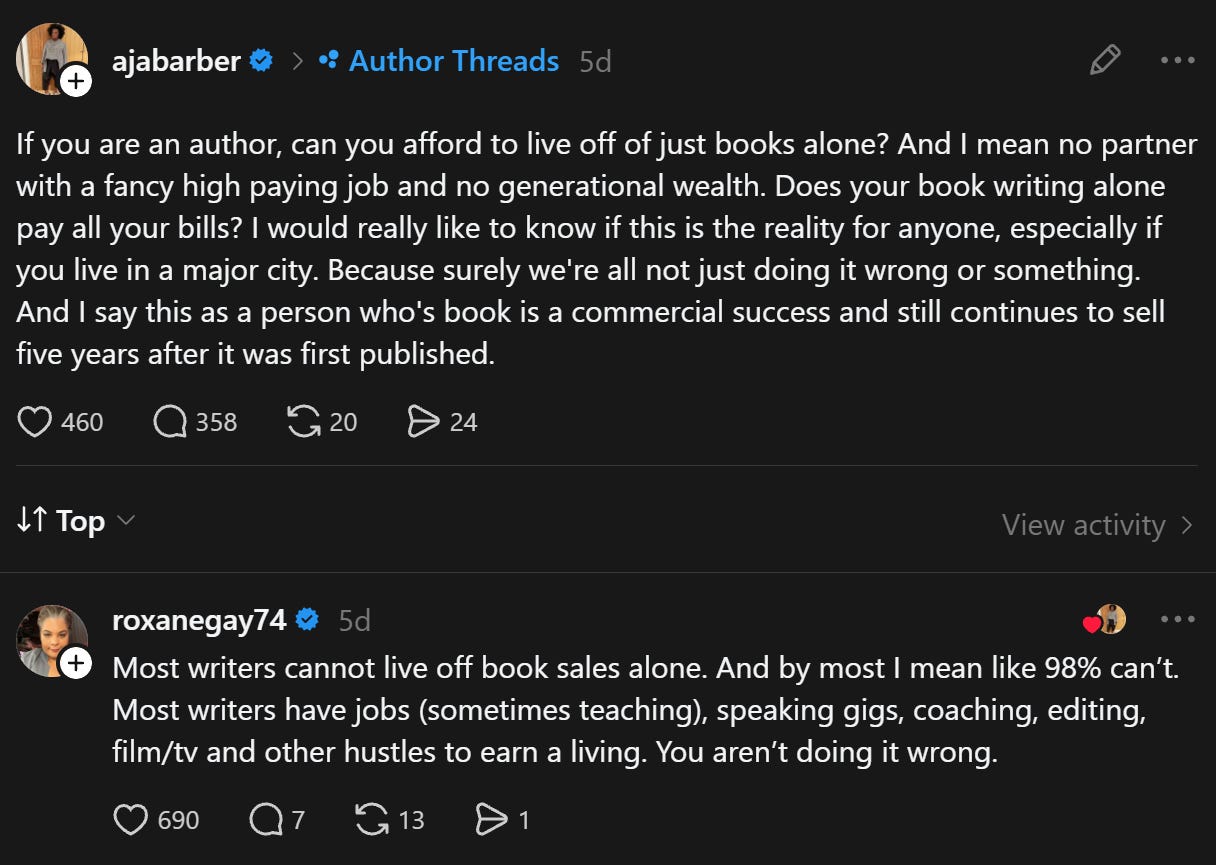
You know how you can walk past the same thing every single day and then one day you actually notice it? That is what it felt like when my mind made the shift to see my professional career as the thing that allows me to write, rather than the thing that gets in my way. I may have said these things before, but I am finally, truly feeling them. Threads conversations like this one help.

2. FEELING TRAPPED IN SOMEONE ELSE’S CAR
I have been feeling trapped a lot lately. Despite my warm and fuzzy thoughts about my job, it is also an area in my life where I am trapped. In my leadership role, I sometimes have less autonomy than I did when I was teaching. Often, my days are at the mercy of others.
Physically, I am trapped in Florida because both my husband’s and my job are tied to the location. I never wanted to live in Florida. Not only is this a weird and embarrassing place to live, but there are no seasons and the only natural landscape that makes it appealing are the beaches--except I don’t really like the beach and we can’t afford boating, not that I would really enjoy that either.
I spend so much of my time living with the consequences of other people’s actions that I sometimes have the sensation that I am riding in the passenger seat of my own life. This has been more pronounced in recent years since the tragedies that hit our family, but I am the kind of person who really likes to make things happen. I’m the kind of person that hears about a problem and bypasses the emotions and feelings and goes straight to solutions.
Being a querying writer has been another way that I put myself in the passenger seat. Sending out my sad little queries, waiting on someone else to read and maybe respond, sending out my manuscript, waiting on an agent to maybe read it and maybe consider taking a chance on my work, checking my Querytracker account to see where I am in the queue…The only way to have any agency in this situation is by continuing to send queries and by responding to whatever feedback you receive with revision or pivoting.
It is more than demoralizing. In the hunt for a golden ticket, the querying process mutates your creative life from something you steer to something you’re begging permission to continue. Believe me. I understand why we do it. I sent a few queries this week. I understand and appreciate the value of a traditional publishing deal, and I can’t imagine a scenario in which I would disparage this choice. If a trad deal came my way, I would probably sign it. The problem is when this is held up as the gold standard, the “right” or “only” way, then it can really make you wonder why you bother writing at all.
Except that I can’t stop writing, and I happen to subscribe to the reader-response theory: I believe a book isn’t truly complete until someone else reads it. On my hard drive it’s just data; it doesn’t become a living story until it travels through a reader’s imagination.
This is a great time for my semi-regular reminder to all those out there struggling to write: if you can quit, quit. If your heart will allow you to let go, let go. I have this suspicion that a portion of writers out there are laboring at this practice with visions of Veronica Roth, Suzanne Collins, Victoria Aveyard, and Stephanie Meyer as their goal posts. “All you have to do is write a great book, and success will be yours and you’ll be just like them.” When I used to attend SCBWI (Society of Children’s Book Writers and Illustrators) Conferences twice a year (2017 - 2020), I sat in rooms filled with mostly women who were all writing young adult fiction in those veins, but the trends in traditional publishing have shifted fairly far from those days and perhaps they’ll shift back. Perhaps not. However, sitting in those rooms and hearing those other writers’ stories, the vast majority had only recently taken up the pen to give it a try with aspirations of financial rewards. After all, the undercurrent of those conversations begged the question, how hard could it be?2
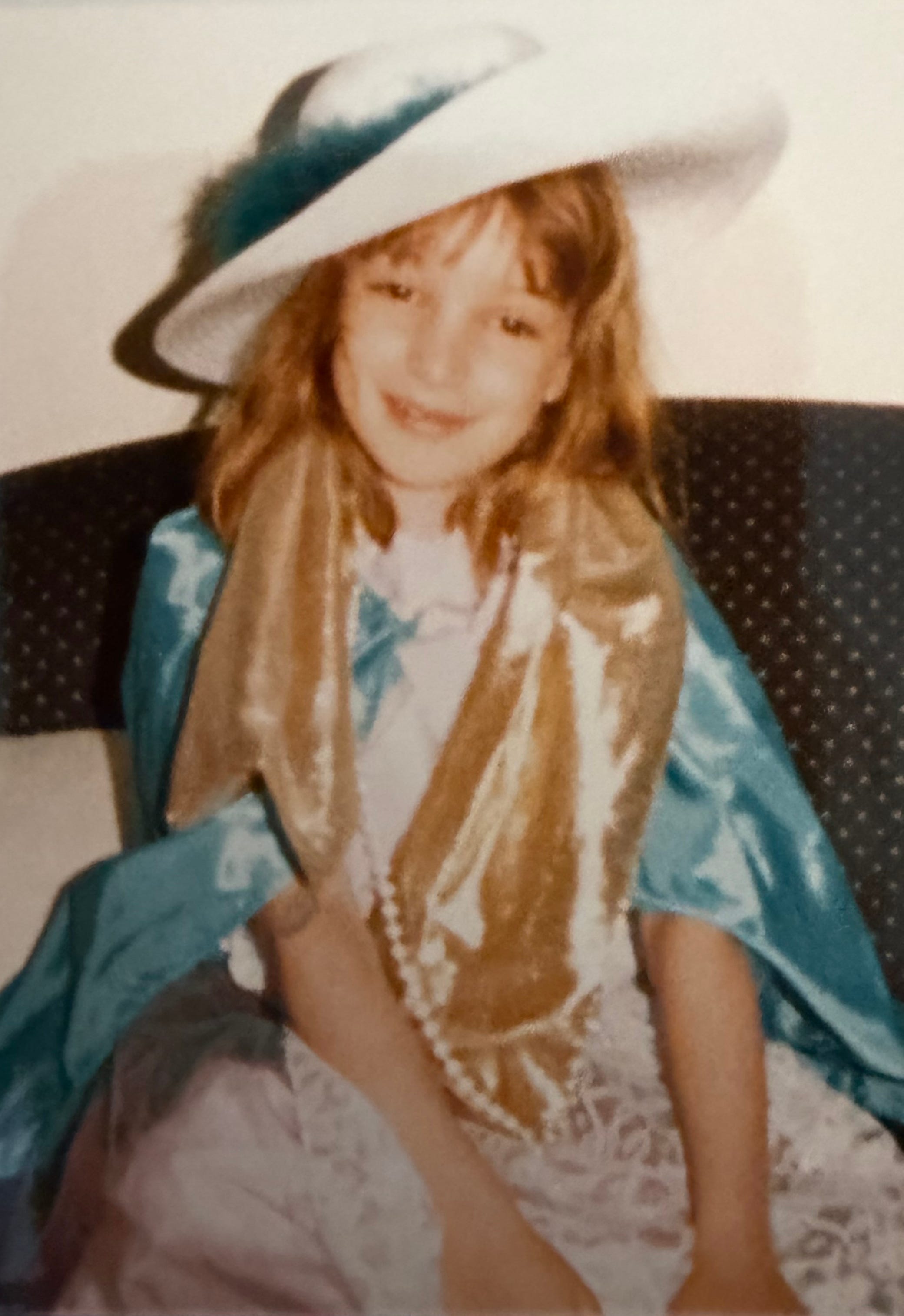
That’s not me. I have been a writer for literally as long as I can remember. I used to crawl under the covers and write in old composition notebooks by the light of my grandfather’s WW2 signal light, which meant that I had to keep the button depressed for the light to shine. It hurt to do this, and yet I kept on writing. Ah, what a metaphor. My guess is that if you’re still reading (or listening to) my newsletter, letting go of your writing is probably not an option for you either. But if writing and storytelling are not long festering seeds in the dark pit of your soul, and you can clearly visualize releasing them…you can without any guilt or shame, the same way anyone might change jobs, find a new hobby, or quit watching a TV show that no longer interests them.
But as is my custom, I have digressed. Back to the metaphorical car. This layer is so personal, but I think after being forced to take a significant step away from writing for a few months at the end of 2025, I’ve gained the perspective to identify the struggle. So many aspects of my life are outside of my control and I lack the resources and freedom to change them. Adding another--querying and permission-seeking--further heightens the feeling of helplessness in the direction of my own life. Yet, the writing and storytelling are part of me and choosing to stay on the path to traditional publishing is exactly that: a choice. It’s a choice I can change, and maybe in the process, change more broadly how I feel so that there is at least one area of my life where I am at the wheel. And if this resonates with you, then I’m glad I decided to share it.
3. SUSPICIOUS OF THE VALUE PROPOSITION
I hopped onto the “traditional publishing” path despite knowing the odds of success and challenges, back in 2017 when I completed the first (horrendous) draft of Kings of the New World. Obviously, I needed to be traditionally published because I do things “the right way” and I like my little gold stars and A+ grades. Besides, as long as I wrote a great book, the right agent would say yes.
No matter how many times a veteran member of the traditional publishing community would say that publishing is not a meritocracy, the idealist in me would also say, but won’t it be for me? Let’s pause to laugh at how cute I was.

Every one of us can point to a book we read (and maybe DNF’d) that we believe didn’t pass muster. We can go to the reviews of our favorite books and find one-star reviews, or the reverse. There is no meritocracy when it comes to art. Yet, trying to apply a faulty system to locate the “best” books to make it to shelves is comical. I recently encountered a bold Substack where a recently-agented author declared there are three things you must have in order to get an agent. Guess what she didn’t list? Luck and timing3.
If “getting published” were an outcome we could control, then it would be a meritocracy and the best books would predictably rise to the top and there would be no lists of self-publishing success stories. In order for that to happen, there would be a standard of measurement, an equitable process for finding and signing with an agent, and so on. None of this is the case because it is are, and art is subjective. I’ve written about it before though, so I’m going to let this go for today.
It’s not just that querying has been an annoying roller coaster for several years straight, but also that I have been tapped into the industry chatter through personal communities and many Substack newsletters and some things (headlines? trends?) are difficult to ignore. I’ve been compiling these data points over the last year or so. Here they are. Nice and organized. With reference links4
Traditionally published books aren’t exactly thriving right now. The Association of American Publisher’s own data shows trade book revenues dropped 9.4% in August 2025 and were down for much of the year overall. Mass market paperbacks were down between 21 to 26% compared with the same time the previous year.5
Publishers are backing away from the midlist. Instead of investing in authors over multiple books, they’re doubling down on “safe bets,” such as, celebrity names, established authors, and debuts with built-in platforms.6
Marketing support is highly selective and decreasing. Roughly 80% of marketing budgets go to about 20% of titles. The rest, often including debuts, get minimal support and an expectation to “build their own audience.” (Not that this is different for self-published authors.)7
Author income isn’t keeping up. According to the Authors Guild’s 2023 survey, which is the most recent I could find, full-time traditionally published authors earned a median of about $10,000 from their books in 2022 while the median income for self-published authors is $24,000 and rising.8
The distribution system is breaking. Book distributor Baker & Taylor, which was nearly 200 years old and served over 5,000 U.S. libraries, shut down in early 2026, thus exposing the fragility of an already shaky system.9
The “Big Five” are consolidating, which isn’t good for authors. The Big Five already controlled 80% of the market when the DOJ blocked Penguin Random House from acquiring Simon & Schuster in 2022, citing harm to authors. This reduces opportunities.10
Leadership and structural changes inside some of the biggest houses also indicate major issues. In just the past year or so we’ve seen leadership changes at Penguin Random House, layoffs at HarperCollins, and entire imprints, like Inkyard (which was on my dream imprint list) shut down.11
I wasn’t wrong in 2017 to believe this was a great path and worthy of my commitment, but… right now, nearly halfway into 2026, let’s just say the shine is dulled.
4. TIRED OF CAPITALISM
I’m tired of A LOT, okay, but I am extra tired of predatory capitalism always being in the driver’s seat. (I don’t know what is with me and the driving theme today. Sorry.) A quick review of the above list makes this point for me. So, I’ll just skip ahead to my next-- HAHAHHA
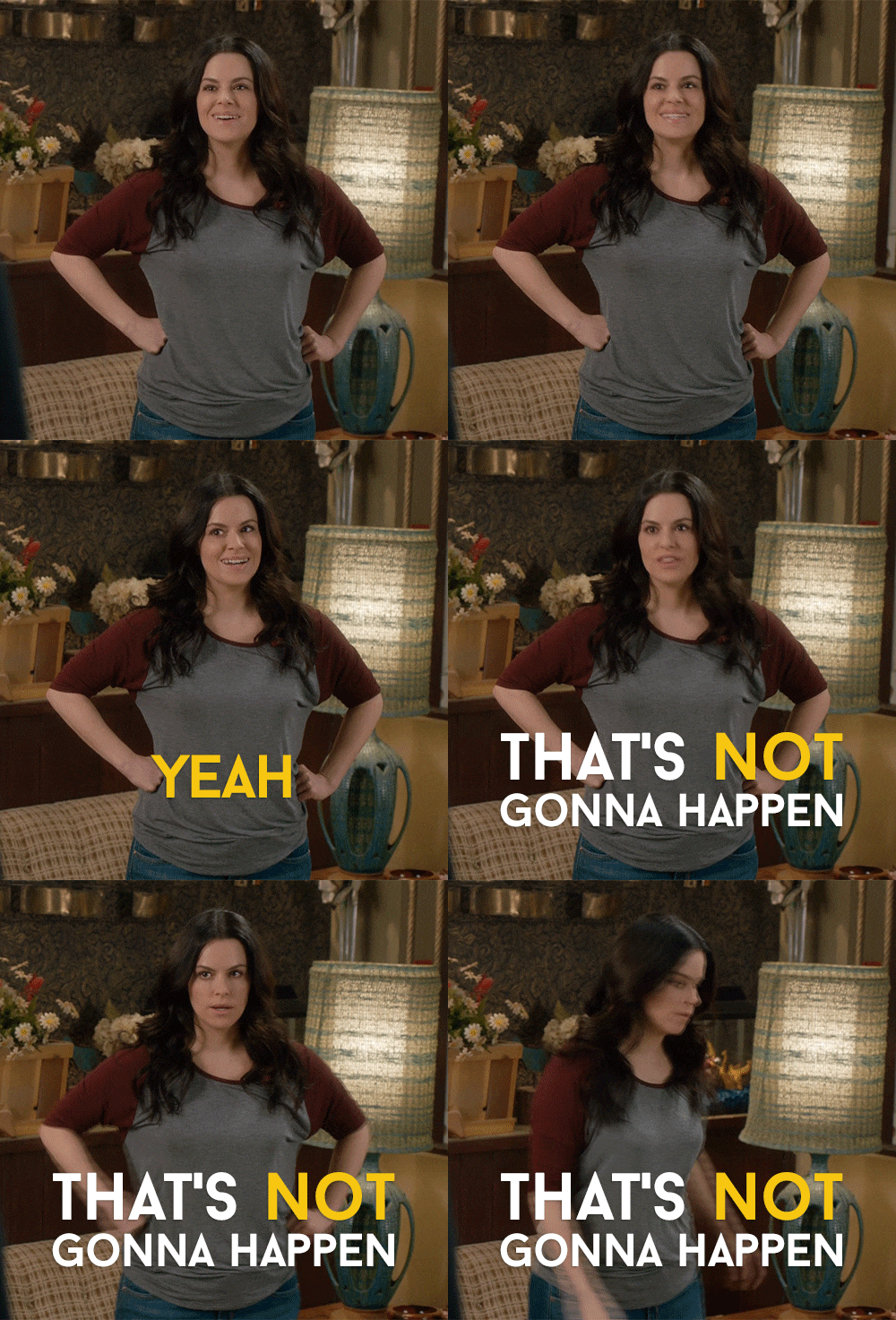
When you grow up in this hellscape of only valuing the profits of any endeavor, it takes deliberate effort to decondition yourself, and that is nearly impossible to do when your very survival revolves around worship of the almighty profit. How stupid, or unhinged, or both, do you have to be to embark on something that is nearly guaranteed to lose you money? And it’s not just that. You have to be in a position to weather the loss. This is not possible for everyone, but I might be able to get there soon.
More importantly, I have finally reached a point where I am okay with investing in my art, even if it is objectionably a poor investment from a financial perspective because, and this is shocking, not everything needs to be viewed from a financial perspective. That is actually a revolutionary statement in the predatory capitalist environment. It feels revolutionary to do something that deliberately goes against the acquisition of the almighty dollar. Reels like this one that popped up while I was writing this post make light of “irresponsible” spending, but that’s the crux of the issue. As the privileged elite continue to suck up wealth and resources, the huge majority of us (by some counts, 90%) are forced into having only enough resources to be responsible. Always responsible. Always doing what we must do because there is no room to do any more. Always struggling to keep ourselves afloat.
Being irresponsible with your money is actually an act of rebellion against this nonsense--an act of rebellion that is still only accessible if you have the resources to do it. Quite a catch-22. I’m not advocating for anyone putting themselves at risk to self-publish a book. It is also an act of rebellion to support independent artists and writers, or, at the very least, to shop at independent bookstores.
Oh, here’s a great moment to promote my writing—which is free. Don’t forget that, KINGS OF THE NEW WORLD, my young adult alternate history dystopian thriller is available to read for free here as serial fiction. Check it out, and share it with someone else who might like it. (Is there ever a good moment for self-promotion? I do not know.)
I’ve been thinking a lot about gatekeepers, too.
Self-publishing changes the gatekeepers but doesn’t remove them. Instead of agents and acquiring editors deciding what gets printed, algorithms decide who gets to see your book. But at least some readers will see those manuscripts and turn them from data into stories, even if I have to fight an algorithm and experiment with marketing (gross) to get my books in front of them.
Letting go of the need to pass through the early gatekeepers (agents, then editors) also bucks the predatory capitalism. When you are creating with the need to sell the book in traditional publishing, you need to write what will sell. In order to sell a book, this means you need to ensure that what you’re writing will appeal to a very, very, very tiny subset of readers: literary agents. By most counts, there are only 1,500 of them. In total. In the whole US of A. That’s it. And among those, an even smaller portion are reported to have the clout needed to move big deals. Then, those agents need to appeal to an even smaller subset of readers: the acquiring editors, and as we already saw, the number of editors is shrinking. In this model, you aren’t writing books for readers. You are writing books in the hopes that one of those 1,500 people likes the genre, needs a book in the genre, likes your concept and unique style, and is open to receiving it. I don’t buy lottery tickets for a reason.
But wait. There’s more…
In a recent article by Karen Gillespie, in which she reviews Laura McGrath’s book about literary agents, Gillespie describes a book that wasn’t acquired because none of the editors it was pitched to could fathom its success. The problem? The main character was a public school teacher and the editors were so disconnected from that aspect of life that it never occurred to them to consider the 40 million public school teachers who exist. Gillespie goes on to say, “The group-think of agents and editors is one of the most interesting points McGrath makes in her excellent book. Publishing people are a homogenous group—mostly white, young females living in New York, and they understandably have sensibilities that reflect their own lives. According to the author, between 2000 and 2022, more novels were set in New York City than thirty other big cities combined.”
Reframing my job as one arm of my diversified income, lets me shove concerns about selling my books way down the line. I still want to sell them--because I want readers--but I’m no longer allowing myself to worry about appealing to that narrow subset of gatekeepers as the means of getting my book off my harddrive.
And, I also believe it might be easier to sell my books to a larger audience that perhaps understands the existence of public school teachers and life outside of New York City. (Was that too snarky?)
5. AI IS AMONG US
I guess we start with my confession: I use AI. Some consider me an expert. But I don’t and will never use it to write my newsletter, my fiction, my posts, my captions, or anything else that represents my voice because authenticity matters to me. The process of writing this newsletter has helped me clarify my thinking, and I would never rob myself of that. I also don’t use AI for art; I only pay human artists for that, which is why you don’t see much art in my work sadly12. But, I do use it at work because it’s an expectation and part of my professional obligation as an educational technologist.
AI isn’t going anywhere. One futurist said that we can’t put the genie back in the bottle. This is true. As long as we are in a system of predatory capitalism with a corrupt government, you can bet that AI will continue to thrive because it’s--at least currently--earning shareholders money and profits drive everything.
The more that big business leans into artificial intelligence, the more I feel like the rest of us, who aren’t benefitting from this tech bro scheme, need to constantly show our humanity in every possible way and especially through our creativity and art. If big business, a.k.a. The Big Five, isn’t the right place for sharing our stories--whether because they don’t want them or because big publishing is falling apart--then what other options are there? The imperative hasn’t changed: we need to be sure that human voices drown out the slop. And there is a lot of slop. In 2025, self-published books increased from 2.5 to 3.5 million titles, and it seems obvious that we have generative AI and lazy “creators” to thank for that spike.
Controversies like the cancelled novel Shy Girl don’t help. If the AI-ness of it all is prompting witch hunts within traditional publishing, does getting that trad deal still hold the same prestige that I used to covet? What good is it to make it past the gatekeepers if the gatekeepers themselves aren’t trusted to keep out the anti-human voices? And if the gatekeepers are being trusted, but big publishing, in their ardent worship of the bottomline, is content to turn a blind eye to AI within their books, then truly what difference does it make where and how your book is published?
Now what?
Not much has actually changed concretely. I’m still publishing KINGS OF THE NEW WORLD as serial fiction here on Substack. I am still working (very slowly) on plans to self-publish my fantasy novel, A TOUCH OF THE DEVIL and should receive my edit letter back before Memorial Day so that I can start final revisions.
Internally, everything has shifted. “Quitting” my pursuit of traditional publishing used to feel like admitting defeat, and it used to feel like condemnation of my worth as a writer. Don’t get me wrong. I am well aware that I have been circling this decision for a long time, but it has always come with a sense of shame: I wasn’t good enough to succeed—it felt like saving for a designer handbag and still only being able to afford a cheap and obvious knock-off.
But now, with all that I have learned and experienced, it feels foolish to stay solely on the path to traditional publishing. I really used to believe the more foolish option was self-publishing and that I was exploring that option for A TOUCH OF THE DEVIL because that was my only choice, but now I realize that it might be the smarter option and a better choice. Certainly, self-pubslihing will give me more agency over my life and art. The door is already open, all I have to do is walk through it.
That’s true for you, too.
I read somewhere that Beltane is the season of the sacred yes because it sits at the threshold to summer, where creativity and life bloom. I wasn’t sure if I would be able to tie this little rant back to the season, but the connection was right there waiting for me.
It is a sacred yes to believe in yourself, and to believe that your writing will find its readers.
As always, thank you for being here. I am a real human, and I would love to hear from other real humans in the comments. And, if you are so inclined, please consider restacking or sharing my work so that I might find even more real humans.
All my best,
I am an executive director of educational technology at a college preparatory school. It is also the school that my children attend, which is a significant perk for which I am grateful.
Someday, I will write an entire post (or more) about this phenomenon and my overall experience being an active member of Society of Children’s Book Writers and Illustrators. There were a lot of great things…and some very strange, not-so-great things.
If you want a link to the referenced post, let me know. Happy to share it individually. I recently saw a major literary agent repost it… because of course they did. It echoes every single thing we are expected to accept as “just how the business works.”
I need you to understand that this is me showing restraint. I had more, and I realized that it was getting way too bogged down.
I am getting some character art done in the next few months, and I am so excited about this!
Thanks for the inclusion!
Oh, and also... Before you mentioned it the other day, the demographic of Editors and Agents had never occurred to me. And if it had, I would have assumed a pile of white women, but also still would have pictured it as more diverse than what you're saying here, and it's just 💀🫠