
We Should Be Friends If...
my personal canon and what shaped my storytelling taste

In my last post I shared how I worked on my personal canon during the summer as a fun self-assigned homework project after I saw people sharing posts like this and this. In the interest of removing some pressure from myself, I’ve decided not to do an audio recording of this post.
Over the course of the many weeks I intermittently worked to curate my canon, I felt myself getting in touch again with the elements of story that most call to me. Unfortunately, burnout swallowed me whole shortly after I finished creating this post. My hope is that revisiting it now and, possibly (hopefully 😄), chatting with others about where our lists align, might help refill my creative well as they say.
The agony of whittling the lists down to manageable numbers was significant. Ultimately, to keep the list lengths manageable, I had to give myself some guidelines. For a title to make my final cut, it had to meet a few criteria for me:
I had to think of it spontaneously (as opposed to searching other lists and adding from those lists to my own). This was probably the most challenging to stick to because I inadvertently stumbled upon lists while this was trending, so I cannot claim 100% fidelity, but I tried!
I had to be able to articulate why I consider it influential to me as a storyteller or human.
Its impact on me had to be unique from other titles. When in doubt, the title I first encountered made the cut.
To prevent my lists from ballooning, I leaned far in the direction of earliest reads and argued with myself to justify why titles deserved to stay.
What follows is a list of books, short fiction, movies, and television shows that represent my personal canon and an exploration of those stories that helped form my storytelling taste.
To all the stories I had to cut: I still love you! You’re still important to me! In honor of your sacrifices, I aspire to post regular notes highlighting all the stories that made the long list but got cut in the interest of manageable list lengths.
Onward…
MY PERSONAL CANON: we should be friends if you see any titles that would make your long list.
I chose fifteen entries for longer work (novels and television shows) and ten entries for shorter works (short fiction and movies).
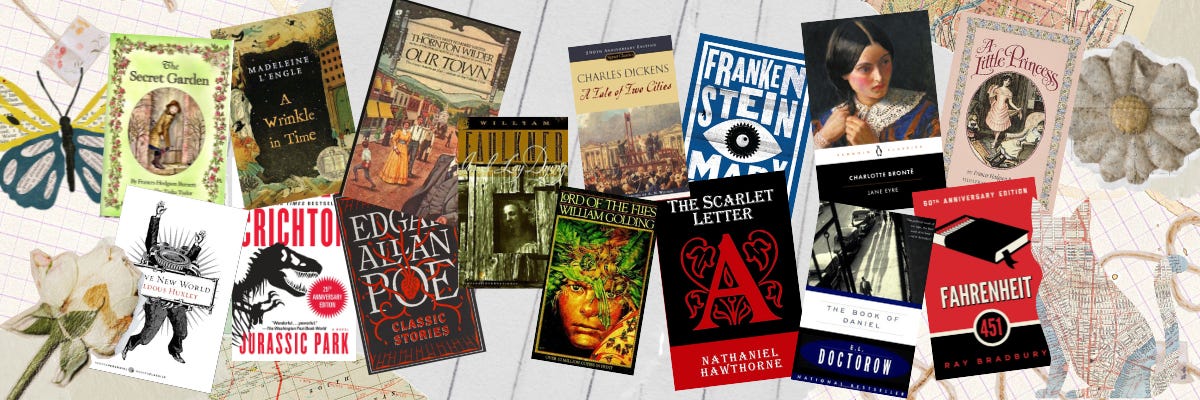
FICTION, full length
As a classroom English teacher for more than a decade, I spent a lot of time with some of these titles as first a student and then a teacher. To the best of my ability, this list is in chronological order for when I read the material.
The Secret Garden by Frances Hodgson Burnett: Gosh, I loved this book. I was a quiet(ish), introverted, lonely kid, and I loved the idea of secret places. In a sad way, I think I was always looking for an escape of some kind that would take me out of my life and into my “true” life, and this book introduced the idea of secret places to me. In my own writing, secret passageways, secret rooms, hidden chambers, etc. figure in prominently and are “id list” items for me.
A Little Princess by Frances Hodgson Burnett: As a kid, I had a special relationship with my dad. He was a single parent for a time, and this book reached into my deepest fears. What would happen to me if something happened to him? I have always been drawn to stories where children are treated poorly and then overcome that treatment. In this book, the ending is over-the-top happy, but this concept of kids overcoming horrendous situations and holding fast to their innate goodness has manifested in nearly every story I’ve written.
A Wrinkle in Time by Madeleine L'Engle: My first science fantasy! I’m writing a science fantasy right now, and I think it’s likely my favorite genre. Also, in gathering up my links for this post, I saw the difficulty she faced getting this book published, and—though I know times have changed a lot—it gives me a glimmer of hope for my work that also might be considered “too difficult.” That’s probably my brand.
The Lord of the Flies by William Golding: I read this in eighth grade and became obsessed with symbolism from this point forward. Then, I taught this book for several years in a row to ninth grade English honors students. The concept of symbolism and allegory stuck with me from reading this novel, and I find as an author that specific objects (conch shell, anyone?) figure into my writing on many levels.
Edgar Allan Poe: I believe, like most folks, I read a few Edgar Allan Poe stories in middle and high school–certainly, “A Tell-Tale Heart,” “The Cask of Amontillado,” and “The Raven” figured into my school reading. This continued in college, where I became overly academic about “The Black Cat,” ultimately writing a term paper about how the black cat symbolized the narrator’s psychosis. Whenever I could, I found a way to squeeze some Poe into my classes. Teens love a good, grisly horror, and Poe delivers. So, naturally, my own creative work tends to lean dark more than not, especially my horror and even my fantasy.
Jurassic Park by Michael Crichton: I was assigned this book for biology class in high school, and it kept me on the edge of my seat, showing me how it was possible for a writer to write so much fear and suspense in a book. Plus, dinosaurs. Also, plus, it was really powerful science fiction. Then, I had the added benefit of being super pretentious when the movie came out, and I could say, “the book was better.” I think this was the time I read a book that was later adapted for the big screen.
“Our Town” by Thorton Wilder: In high school, I had to memorize and perform Emily Webb’s Act III soliloquy for my drama class. It was the first time I really thought about how quickly time passes us by, and I’ve never been the same since. Something I grapple with as a writer is balancing how much time I am willing to give over to my pursuits, and though this is not a direct influence on my storytelling, it directly influences my mindset on writing.
Fahrenheit 451 by Ray Bradbury: Dystopia! Questioning common cultural trends! I love dystopian work because I believe there is no better way to consider the current faults of society and government than to conduct the thought experiment of extrapolating the current trend to one extreme, or even likely, future conclusion. Fahrenheit 451 is the first book to open my eyes to how we can do this through literature. As a writer, half of my completed manuscripts are dystopian: Kings of the New World and my futuristic sci-fi. My WIP, a science fantasy has a strong dystopian lean as the premise is humanity’s first off-Earth civilization, governed by an AI. If a book is dystopian1, it’s pretty much an automatic read for me.
A Tale of Two Cities by Charles Dickins: What can I say? I loved the interweaving of many characters all against the conspiracy and rebellion of the French Revolution. I really enjoyed seeing how all the characters and subplots would cross into each other, and I learned that I love secret identities. Those show up all the time in my writing, but I can’t name which books because spoilers.
Frankenstein by Mary Shelley: How cliche am I? Not only do I love a good science fantasy (as previously established), but I am a big fan of the macabre (as previously established). This was the first book to combine those with sophistication while adding the horror elements I love. I can see the impressions of Mary Shelley throughout my speculative work.
Jane Eyre by Charlotte Bronte: I remember feeling bad for all the heteronormative boys who had to read this book with the class. Our junior year British lit teacher went all in and followed Jane Eyre with Rebecca by Daphne du Maurier, Wuthering Heights by Emily Bronte, and Return of the Native by Thomas Hardy. What puts Jane Eyre above the cut for me was the romance. Yes, it includes secrets, conspiracy, darkness, and a child overcoming significant hardships in their youth (all themes previously added to my canon from other titles), but the romance seemed to buck all traditions for me. I like that Jane wasn’t beautiful and that Mr. Rochester was far from perfect. All of this spoke to me as showing that romances do not have to be Hallmark-y to work; Hallmark is what I would call anti-brand for me.
As I Lay Dying by William Faulkner: This book was the first book I remember reading that contained multiple POVs, and all 15 were distinct. Would I ever read it again? No. I don’t remember being riveted by the story, but I was impressed with voices and intrigued by the way Faulkner presented varied perspectives within one plot. I thoroughly enjoy writing in multiple POVs and often struggle to contain my storytelling so that a single POV is sufficient to share the scope of the tale. I will also never forget the five word chapter: “My mother is a fish.” and how it inspired me to harass my own mother and her irrational behavior by printing little slips of paper stating “My mother is an armadillo.” all over the house. Fun fact: when I lived in northern Florida, we would often see dead armadillos on the road. It turns out that armadillos are short enough that cars can pass over them leaving the armadillos unscathed; however, the armadillos, sensing the oncoming danger, jump to see what’s coming2, and *splat.* My mother’s logic seemed aligned with armadillo logic in most things.
The Scarlet Letter by Nathaniel Hawthorne: The illicit romance. Need I say more? Oh wait! Secret identities again! This book also grappled with nascent issues of women’s rights, first fomenting my serious questioning about our Puritanical roots. As a direct descendent of the first settlers from The Mayflower, it was hard for me to untangle the Puritanical and patriarchal inherent in my family’s lore. This book opened a window to that–and also introduced me to heartwrenching possibilities of forbidden love. (Too bad it was written by a man, LOL.)
The Book of Daniel by E.L. Doctorow: Read at university. This is a book that I would not read again because of how difficult the content was. The Book of Daniel features a sort of retelling of the trial and execution of the Rosenbergs from the point-of-view of their fictional children. It changed my views on politics, government, and execution.
Brave New World by Aldous Huxley: Another dystopian? Yes. But this one hit me differently than Fahrenheit 451 for a few reasons. Huxley speaks to larger societal trends in terms of the social stratification, the deliberate distraction of the masses, and the debasement of our authentic human desires for connection and art. The fact that he wrote this in 1932 makes Huxley something of a prophet. I first read this book in preparation for teaching it to my ninth grade English honors students, and I am grateful for the several consecutive years in which I could discuss the themes of this book with my students. I would be interested to see how it lands now, only a decade later when so much has already shifted.
SHORTER FICTION
“The Velvetine Rabbit” by Margery Williams Bianco: I will never forget the utter horror I felt when I learned the rabbit’s fate. I never read this one to my kids because the heartbreak I remember feeling for both the boy and the rabbit was more than I could bear as a child. Oddly enough, I am perfectly fine writing that kind of trauma into my own work, though, like “The Velvetine Rabbit,” I prefer that my stories end on a hopeful upswing, if not fully resolved with a happily ever after.
“Winnie the Pooh and the Honey Tree” from Walt Disney’s Treasury of Children’s Classics published 1978, edited by Darlene Geis: Winnie the Pooh and his friends were my friends. I read a lot of the Pooh stories by A.A. Milne, but this story was a favorite. Mostly, it was a lovely reprieve from “The Velvetine Rabbit.” (Lol) I enjoyed Pooh’s ensemble cast, and, as silly as this may sound, having an ensemble cast of friends remains important in my writing. My science fiction One Last Life is a great example.
“Robin Hood” from Walt Disney’s Treasury of Children’s Classics published 1978, edited by Darlene Geis: I have loved all things Robin Hood since I forced my father to read this story to me on repeat as a kid. The idea of stealing from the rich and giving to the poor is quite appealing–so much so, that my fantasy is a Robin Hood retelling with a darker, more vengeful edge.
“Lamb to the Slaughter” by Roald Dahl: If this short story were in the news, the headline would be: “Murderer Feeds Weapon to Police.” Love it. I also loved The Witches by Roald Dahl, but it didn’t quite make the cut for top 15 books3.
“The Lottery” by Shirley Jackson: I read this one in middle school and taught it to my freshmen. Did I orchestrate my own version of the lottery with paper slips and dots? Totally (but the reward was candy, not being stoned to death). Ever since reading this story, the concept of culling populations has popped in the stories I write. I don’t always follow that thread, but it does like to wave at me. I think you can read it here.
“The Most Dangerous Game” by Richard Connell: Alright, so I can see where my dark leanings manifested. Anyway, trapped on an island? Evil and brilliant villain? Isolated settings are something I enjoy working with in my writing. My horror, Before The Bridge Freezes, takes place on a remote island that is iced in during winter.
“The Yellow Wallpaper” by Charlotte Perkins Gilman: This story got under my skin. This story was the first direct examination of unraveling mental health that I read, and my interest continues.
“Smith of Wootten Major” by JRR Tolkien: This was my first Tolkien. There’s a cake, a magical star, and a festival. I have a vivid memory of reading the description of the cake, which is critical to the story, and feeling amazed at how much I could imagine tasting that cake. I notice that I tend to have festivals or big festival-like events in my work (and wow, do I love cake). You can read more about it here.
Bottle Caps for Tralla La: This was assigned reading for one of my advanced literature courses in college, and I think about this comic all the time. You can read a better summary here, but I’ll do my best to explain how it makes the cut. This comic shows how quickly money corrupts, and the creator expertly eviscerates capitalism with cartoon ducks: “The bottle caps he [McDuck] discards are considered rare treasures in Tralla La and become the basis of a new monetary system.”
“There Will Come Soft Rains” by Ray Bradbury: August 5, 2026 is coming in almost exactly a year; I hope Bradbury wasn’t a prophet. Yes, the story is a nightmare. I used to teach it to my freshmen alongside Brave New World. Revisiting it now feels even more eerie.
How many titles do we have in common so far? Let me know in the comments.
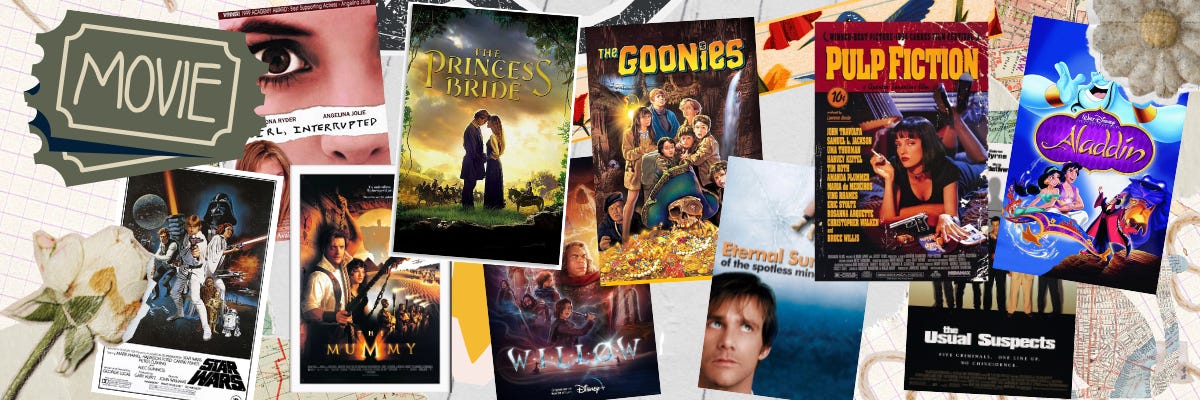
MOVIES
Star Wars: A New Hope (1977): For my kindergarten graduation, I refused to wear the cap because it didn’t fit over my Princess Leia’s braids. The ultimate science fantasy, this movie has everything I love: hero’s journey, esoteric magic, a bad-ass princess, a rogue, droids, bounties and bounty hunters, spaceships. Which happened first? My love of those things or this movie? I’ll never know.
The Goonies (1985): As a kid, I always hoped for some kind of adventure, and I was fairly certain that I was a misfit who might have found belonging among a group of misfits. I also loved that the kids were rescuing their parents from the big, bad rich folk (see Robin Hood). Those themes of found family and underdogs appear rather frequently in my work now.
The Princess Bride (1987): At this point, I feel like a cliche. I tried reading the book, and the narrative style did not grasp my attention but I can watch this movie regularly and never get bored. It has so much that I love and rodents of unusual size. I wanted my Robin Hood reimagining to hit the same tones as The Princess Bride, but my creativity naturally leans way too dark (see Poe and most of the short stories). What my fantasy does have, that is directly inspired by this story, is a rag-tag group of outcasts and criminals on a high stakes adventure across a wide range of terrain, including carnivorous rodent-reptile mutants.
Willow (1988): I know (saying this with a heavy sigh) that reviews on this movie are fairly terrible and deserved, but hear me out. This movie was the first (wannabe-epic) fantasy that showed me how much bigger a world could be–all the different kinds of people making up a vast world filled with potential. After rewatching, I saw a lot of borrowing from Tolkien, but Madmartigan (Val Kilmer) as a “bad guy” who could become good opened up the whole idea of character growth to me, and I now love a great redemption arc.
Aladdin (1992): By far, Jasmine is the best Disney princess. Change my mind. Abu is adorable. The Genie is hilarious. Rajah is fierce. Aladdin is selfless, and his character is the one that seems to influence how I write some of my male characters to this day. I love an antagonist whose ambition does him in, like Jafar.
Pulp Fiction (1994): This was the first Tarantino film I saw, in the theaters. Later, my English teacher, in front of the entire class, announced that I reminded her of Uma Thurman from the movie (you know, the character who overdoses on cocaine, so that was cool). Tarantino’s film opened my eyes to interweaving storylines–something that forever changed storytelling for me.
Usual Suspects (1995): "The Greatest Trick The Devil Ever Pulled Was Convincing The World He Did Not Exist." ~ Verbal, The Usual Suspects. Screenrant says that this is the greatest mystery film ever created. I agree. I don’t write mysteries directly, but I like for my work to have puzzles for the readers to unravel, and there are always elements to “figure out” for my readers.
Girl, Interrupted (1999): Growing up, I knew my mother’s mental health was not excellent, and I was told, regularly, not to turn out like her. This movie cast mental health struggles in a strange light, so it was not the depiction that I appreciated as much as it opened the door for me to think a little more deeply about mental health struggles and what appropriate treatment might have done to change the course of my mother’s–and therefore my–life. My horror has elements of this theme woven throughout it.
The Mummy (1999): I am a cliche. Anyway. The treasure, the curse, the librarian, the rogue. This movie has to be in the canon for the perfect blend of all the elements I love in a great story. Watching this movie is also when I realized that the most entertaining—for pure fun—movie genre is the action comedy. I hope that I occasionally get elements of comedy into my work; it is a skill I work on regularly.
Eternal Sunshine of the Spotless Mind (2004): I’ve only seen this one once. I will never watch it again, but it completely changed the way I think about memories, heartbreak, and emotional pain. I don’t think I want to write something that would press all of these buttons, but I would love to someday hit readers with a story that reorients their thinking on some aspect of life the way this movie did for me.
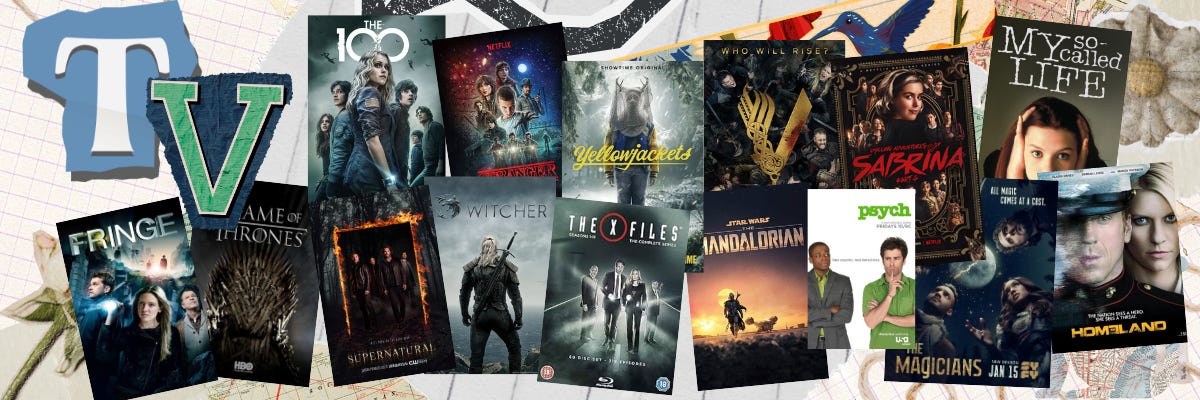
TV SHOWS
This list challenged me more than I expected. I did not watch much television until well into adulthood, with a few exceptions. The first item on the list is one great example, but other shows–like X-Files–I ended up watching on syndication or streaming later. Of the content in my canon, the television shows are the most recent, but the trends of what speaks to me shines through.
My So-Called Life: This show was my senior year of high school, and it spoke to me. In stark contrast to 90210, this show did everything it could to portray adolescence authentically. As I wrote about here, my one hope is to be as authentic as possible in capturing the emotional complexities of being a teen.
X-Files: The truth is out there, Fox! Conspiracy theories, aliens, and the unexplained, plus brilliant Scully keeping Mulder in check. It’s a perfect show, and I have loved mining potential conspiracies for story. My serial fiction is a great example.
Psych: I loved watching this show the first time through, and now that I’m rewatching it with my youngest son, I can confirm that it holds up over time. Again, the love of ensemble casts and mysteries has clearly influenced my work.
Fringe: Very similar to X-Files, Fringe deals with the unexplained, but with parallel universes exploring the ripple effects of decisions. I love considering how every decision creates a fork in the road, and though I doubt I will ever write something that goes as deeply into this concept as Fringe, the thought exercise helps with plotting.
Supernatural: I confess that after bingeing this show for over a year, I quit watching the last few seasons because I accidentally saw a spoiler and could not get to the end. Monster hunting and the supernatural living among us features heavily in my horror.
Homeland: I loved the intensity of Danes’ character and how she is extraordinary despite her mental health struggles. As far as its influence on me, I think I learned a lot about suspense and mystery from the writing.
Game of Thrones: Predictable entry, but here we are. I think I am finally ready to admit that I would love for my work to expand into epic territory. My adult science fantasy world building is expansive enough to reach “epic” status; my fantasy has enough steam as well. What keeps getting in my way (through traditional publishing) are the word count limits literary agents auto-reject: they seem to get lower and lower.
The 100: This show mixes dystopia, clan rivalry, and teens fighting to fix the mistakes of their parents. The first book of my dystopian serial fiction nails the teens fighting to fix their parents’ mistakes, and, if I ever buckle down to write the second book, clan rivalry will be front and center.
The Magicians: I love the college, real-world setting mixed with the portals. Did I watch season five? Nope. I digress. From a storytelling lens, there is something really appealing about the university setting. A significant portion of my science fiction, One Last Life, takes place in a futuristic university.
Vikings: There is something so appealing about the brutality of this show (okay, I watch the spin-offs, too) that is so riveting. I really need those life-or-death stakes apparently and never really write anything “quiet.”
Stranger Things: So many Goonies vibes but much longer with much scarier evil to battle–and the supernatural. My YA horror is comped to Stranger Things for the strange, scary creatures crossing into the “regular” plane of existence.
The Chilling Adventures of Sabrina: A perfect blend of mystery, horror, teen drama, and the supernatural. This show hits the right storytelling notes for the kind of YA that I hope to share with my readers—plus, the overall dark tone and the many ancient magical artifacts are right off my “id” list.
The Witcher: Will I keep watching with the casting change? Probably. I also enjoyed the books from the series, though I haven’t finished reading. Again, the theme of the supernatural comes through, and a specific element of magical tea brewing that I incorporating in my fantasy is both an “id” list item and influenced by Witcher potions.
Yellowjackets: The interweaving timelines, the horror, the cannibalism, the nineties, the strange eerie potentially supernatural influences. No, I’m not caught up. Please don’t spoil things for me. (Cannibalism and survivalism are “id” list items for me—don’t ask.)
The Mandalorian: Show me the child. Space western (a.k.a. genre-blending). Star Wars. Grogu. Strange cult-like organizations. Conspiracies. Corrupt governments. It has all of the things I love and hope to incorporate in my own storytelling.
There you have it! But…
Something I noticed that I want to shine a light on, however uncomfortable it makes me. I need to call out the lack of diversity in my personal canon. By setting forth the restriction that I would choose the first title I encountered if several titles similarly influenced me, I locked myself into my earliest readings.
As a child and student of the 80s and 90s, I was locked into the assigned readings of my education and the books my parents bought for me. I can’t claim Beloved, The Bluest Eye, and Song of Solomon by Toni Morrison (which I loved but read late in college), the exceprts from Frederick Douglass (which I taught my high schoolers), or the poems of Langston Hughes or June Jordan4 did not impact me, but the truth is simple: my exposure to diverse voices was limited in my formative years.
If this shows me anything, it’s that access and exposure are absolutely necessary. I was a curious kid and avid reader. If more diverse books had been around, I’m confident I would have read them.
We know that reading makes people more empathetic, and if we want our kids to learn how to appreciate, value, and learn from each other, we need to ensure that kids have access to diverse stories beginning in formative years. Don’t take my word for it though: check out We Need Diverse Books for more information. (Update as of 9/15: WNDB + NetGalley collaborated on a reading challenge. Check it out here.) As I have gotten older, my reading has expanded by interest, coincidence, and deliberately seeking out diverse perspectives in my fiction. Regardless of author, the story elements that appeal to me remain fairly consistent, and I look forward to sharing more through Notes in the near future.
Let’s connect.
Do we have anything in common? Please let me know if any of my list items are on yours, too! I would love to chat about it in the comments.
Until next time,
Legend Trilogy by Marie Lu, Divergent Trilogy, by Veronica Roth, The Hunger Games by Suzanne Collins, etc. etc. etc.
I tried to find a reference to link to, so that you wouldn’t think I was exaggerating, but the first three pages of search results all linked to TikTok and Facebook videos which made me irrationally annoyed, so I gave up. Take my word for it please.
15 felt like a good place to cut it off because once I started approaching 20 the list started to balloon. I’m excited to share the rest of my lists on a weekly Notes posting series I’m planning.
If I included poetry on this list, June Jordan would be at the top.
Nice list. Many similarities to what I would have chosen. Now, I am secretly worried you're somewhere inside my head sucking out my literary influence juice! :-)
Now I want to do one of these. Mine would have less wonderful literary classics and more Babysitter's Club lol.